Attention Ophthalmology ST1 applicants
Why do good candidates lose points on their portfolio?
The answer is thirty seconds down this page
The rules are complicated.
Your portfolio is scored against a set of rules that most candidates only read once. It's scored by two assessors who know the rules like the back of their hand and have applied those rules to score dozens of portfolios.
Our coaches find that almost every portfolio they look at has mistakes in it. Evidence is incomplete, put in the wrong section, or simply isn't worth as much as the candidate thinks it is.
Every domain has a cap
Each scored domain stops counting at its cap, and points past it are lost. A seventh point in Publications is worth nothing, and it does not carry over to another domain. The item behind it can: if it qualifies under another domain that still has room, claim it there and it scores.
One piece of work counts once
“Evidence cannot normally be used in two different domains.” The same audit cannot score in Quality Improvement and again in Presentations, so claim it where there is room.
Padding is not free
The guidance warns that “marks may be deducted for including unnecessary information”. It requires good judgement and understanding of the rules to know what information is necessary, and what isn’t.
A paper needs its paperwork
A peer-reviewed paper must be PubMed-cited, in a journal with a current Clarivate Journal Impact Factor, with the first page attached, and evidence of final acceptance as well if it is in press. PubMed alone is not enough.
Some evidence expires
Quality improvement and audit must fall within three years of the interview. Multi-source feedback must fall within 18 months of the interview date if you have been in clinical posts for that period. Out of a clinical post with none in that window, include the feedback from your most recent clinical post.
The 2027 rules are stricter
Five domains tightened for 2027. A first in any year but the final year no longer scores as a prize, and a supervisor’s letter alone no longer earns 4 or 5 points for quality improvement: the data has to be uploaded too.
“It was an absolute headache to understand the evidence folder scoring framework, and I self-assessed incorrectly in multiple places. SmartOST made it really clear and helped me improve my score”
Your portfolio counts for half your final ranking.
A point you earned but cannot prove is a point the assessors cannot give you. Find it now, with the evidence behind it, and it counts at every stage that follows: the invitation to interview, and half of your final total.
Three things, one portal.
Three things go in while the portal is open, from 18 January to 2 February 2027. Miss any of them and you will not progress.
Your scores on the MS Teams form
Your score for each domain, submitted on an MS Teams form. The instructions arrive shortly before the portal opens.
The Self-Assessment Proforma
The same scores again, each with about 50 words of justification. The proforma is the first document you upload to your evidence folder.
Your evidence folder
The evidence for your score: certificates, letters, papers and data. These are grouped per domain and each domain is uploaded separately to the portal. Marked out of 50 across 10 domains, 9 of them scored.
Evidence folder score breakdown: 10 domains, 9 of them scored, out of 50
- Previous PostsDeclarative. You list them, they do not score.0
- QualificationsAdditional degrees, separate from your primary degree.5
- Prizes and Awards5
- Multi-Source Feedback2
- Quality Improvement and Audit5
- Presentations6
- Publications6
- Education and Teaching5
- Specialty Links and CommitmentThe largest domain by some distance.13
- Overall Portfolio Layout and Quality3
How the score is used.
Your folder is marked out of 50, and 3 of those points are for its layout and organisation, so how it is presented counts as well as what is in it. You score yourself on the other 47, and you need at least 19 points to go further. Above that line, your MSRA score alone decides who makes the top 350.
Two assessors verify the folders of the top 350. Anyone verified below 20 drops out, the top 260 are invited to interview, and the verified score is half of your final total. The interview is the other half.
NHS England: Self-assessment and supporting evidence; Selection process; Scoring, ranking and offersPoints past a cap are lost. The paper behind them is not.
Three first-author papers in Ophthalmology journals, each PubMed-cited with an impact factor. Claim all three under Publications and the domain stops at its cap of 6: the third paper's points are lost. Specialty Links also scores a first-author Ophthalmology paper not used in Publications, and it has room. Claim the third paper there and it earns a point.
- PublicationsPaper A, first author3
- PublicationsPaper B, first author3
- PublicationsPaper C, first author3
Claimed 9Scored 6
Three good papers, one domain. The third paper's points fall past the cap and are lost.
- PublicationsPaper A, first author3
- PublicationsPaper B, first author3
- Specialty Links and CommitmentPaper C, peer-reviewed Ophthalmology paper1
Claimed 7Scored 7
Same three papers, each claimed once. The third earns its point under Specialty Links, which has room for it.
Specialty Links scores a peer-reviewed Ophthalmology paper not used in Publications only if you are its first author, up to 2 points for such papers.
Score yourself the way the assessors will.
A spreadsheet adds up whatever you type. A template gives you headings to fill. SmartOST shows you what each item scores and what evidence it needs, and applies the caps for you. The judgement calls stay yours, with the rules right beside them. Then it turns each domain into a separate PDF, ready to upload to the portal.
| SmartOST | A spreadsheet or template | |
|---|---|---|
| Caps | Every domain cap, sub-cap and per-item limit, applied as you add evidence | Adds up whatever you type |
| Warnings | Tells you when an item goes past a cap, and how much of it will count | Silent |
| Rules | Scores against the 2027 evidence folder rules | Whatever rules you copied in |
| Proof | The document that proves each item, attached to the item | Files kept somewhere else |
| Planning | Work in progress, with its dates, on a calendar beside the cycle's key dates | A to-do list you keep yourself |
| Output | Each domain as a separate PDF, ready for upload to the portal | Assembled and laid out by hand |
From a pile of documents to portal submission.
Start with what you already have. Most of the form carries no time limit, so work you stopped counting years ago may still be claimable.
Add your evidence
Record each item under its domain, and attach the document that proves it.
See your score
Your total updates as you add each item, and every domain shows its points against its cap.
Close the gaps
Mark work in progress with its dates. The calendar shows it beside the cycle's key dates, so the points still to come have a plan.
Export the folder
Generate each domain as a PDF, with a contents page and your evidence inside, ready to upload.
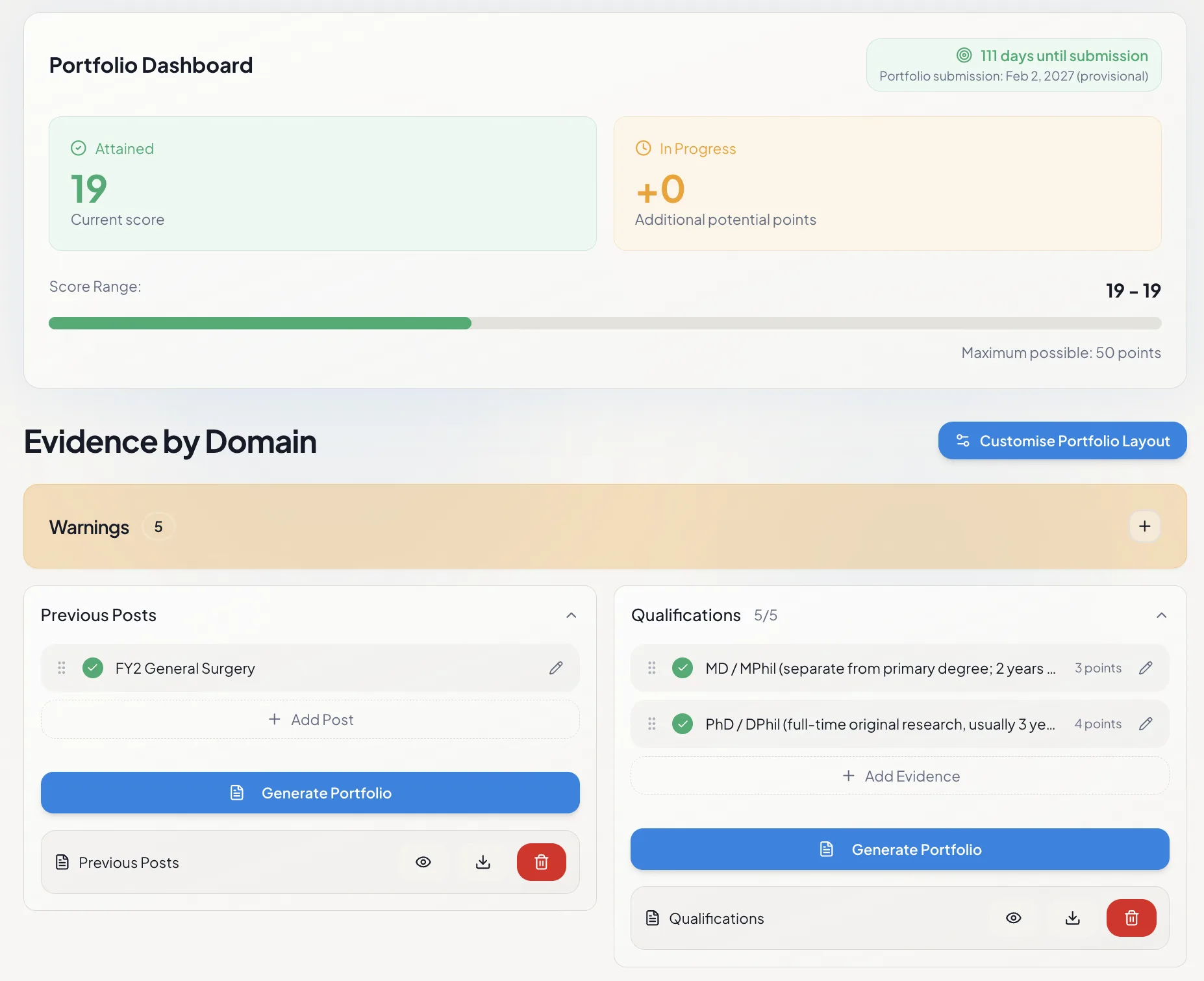
Your whole portfolio on one screen.
The score you have, the range it could reach with the work in progress, the days left until submission, and every warning to fix before you upload. Then the evidence itself, domain by domain.
The SmartOST team
A team that knows Ophthalmology ST1 and knows how to build AI products.
SmartOST was born out of Keane AI's research lab, combining top-ranked London North Thames Ophthalmology trainees with AI researchers and engineers. We bring the practical know-how of getting into training and the technical expertise to build tools that make preparation smarter, faster, and less stressful.

Dr Mertcan Sevgi
Co-founder & Coach
Ranked in the top 1% of applicants, securing a spot as an ST1 in the London North Thames deanery. Brings startup and scale-up experience, with a focus on voice AI and user-first product development.

Dr Virginija Vilkelyte
Coach
Ophthalmology trainee (ST1, Moorfields Eye Hospital) and top-scoring applicant in national ophthalmology specialty training selection. Helps aspiring ophthalmologists maximise their portfolio and interview performance, giving them the best possible chance of securing an ophthalmology training post in their preferred location.

Dr Vanessa Otti
Coach & Content Lead
Ophthalmology registrar (ST2, London North Thames), ranked in the top 1% of applicants nationally. Creates curated, high-yield learning resources delivered straight to members.

Dr David Merle
Co-founder
Retinal specialist and Senior Research Fellow in the Keane AI Lab. He is currently driving development of our next products, designed to support you as you begin ophthalmology training. Stay tuned for updates.

Dr Negin Sanadgol
Intern
Clinical Research Fellow with Keane AI. At SmartOST, Negin is leading on quality improvement projects to measure and improve our impact.
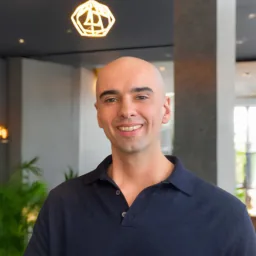
Frederick Lewis
Founding Engineer
Engineering degree from Imperial College London. Software and AI engineer building fast, reliable, user-first product experiences at SmartOST.

Professor Pearse Keane
Strategic Advisor
Professor of Artificial Medical Intelligence at the UCL Institute of Ophthalmology and Consultant Ophthalmologist at Moorfields Eye Hospital. Founder of the Keane AI lab.
What applicants say after using it.
“My portfolio took me a full day to put together before. With SmartOST Portfolio it took about 30 minutes.”
“It was an absolute headache to understand the evidence folder scoring framework, and I self-assessed incorrectly in multiple places. SmartOST made it really clear and helped me improve my score”
“The PDF generator is so clean. I was genuinely worried about how my portfolio looked and this fixes it.”
“The one-click PDF export is exactly what I needed. Everything comes out neat and ready to upload.”
“The calendar view is amazing. I can actually plan how I'm going to get the points and track what I've done. Thanks so much SmartOST team.”
Simple pricing
SmartOST Portfolio
Your evidence folder, scored and laid out, ready to upload. Pay once, and only when you want every domain.
Every domain exported as a PDF, ready to upload
Access for the Ophthalmology ST1 2026/2027 application cycle
Don't take our word for it.
Scoring is free, so you can see it work first. If you buy the full export and it isn't what we promised, email us and we'll give you your money back.
Questions?
We've got answers.
Spare one evening, and know the score the rules allow you.
Add what you have, domain by domain, and see where the caps bite and where there is still room. Then decide whether every domain as a PDF is worth £19.99.
Scoring it is free.
P.S. If you reach verification, two assessors will check every point you claim against the rules on this page. Scoring your portfolio first is free, and the refund covers the export.